> For the complete documentation index, see [llms.txt](https://help.sbtinstruments.com/llms.txt). Markdown versions of documentation pages are available by appending `.md` to page URLs; this page is available as [Markdown](https://help.sbtinstruments.com/advanced/advanced-sample-preparation/hit-the-right-concentration/concentrate-your-sample/filter-centrifuge-your-sample.md).
# Filter-centrifuge your sample
## Overall procedure
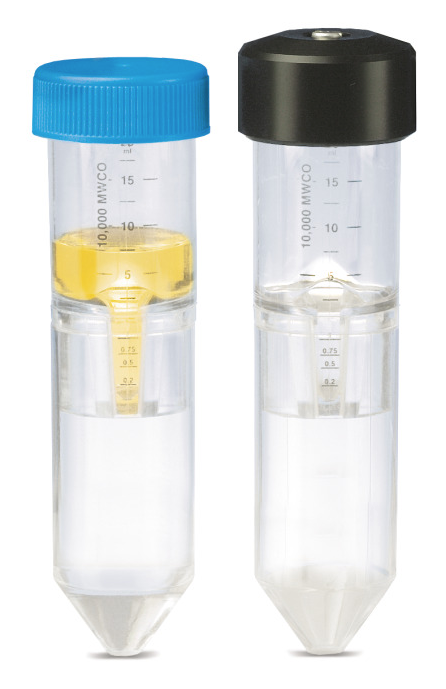
Use a centrifuge tube with a built-in membrane filter (like the tubes pictured above). The overall steps are like this:
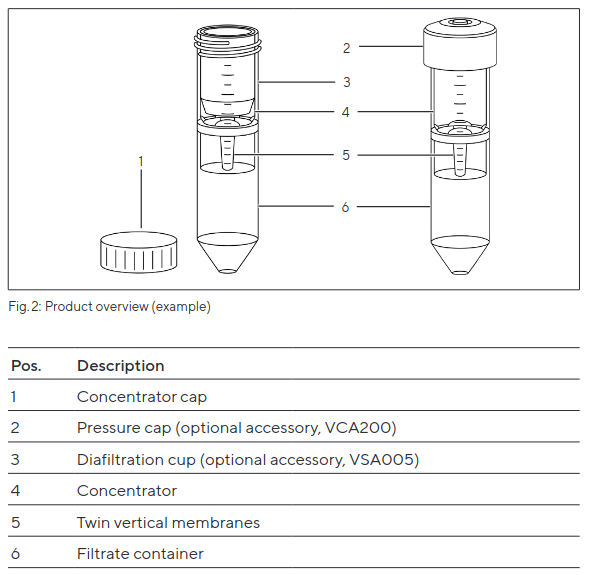
1. Load your sample into the concentrator (4 in the figure below)
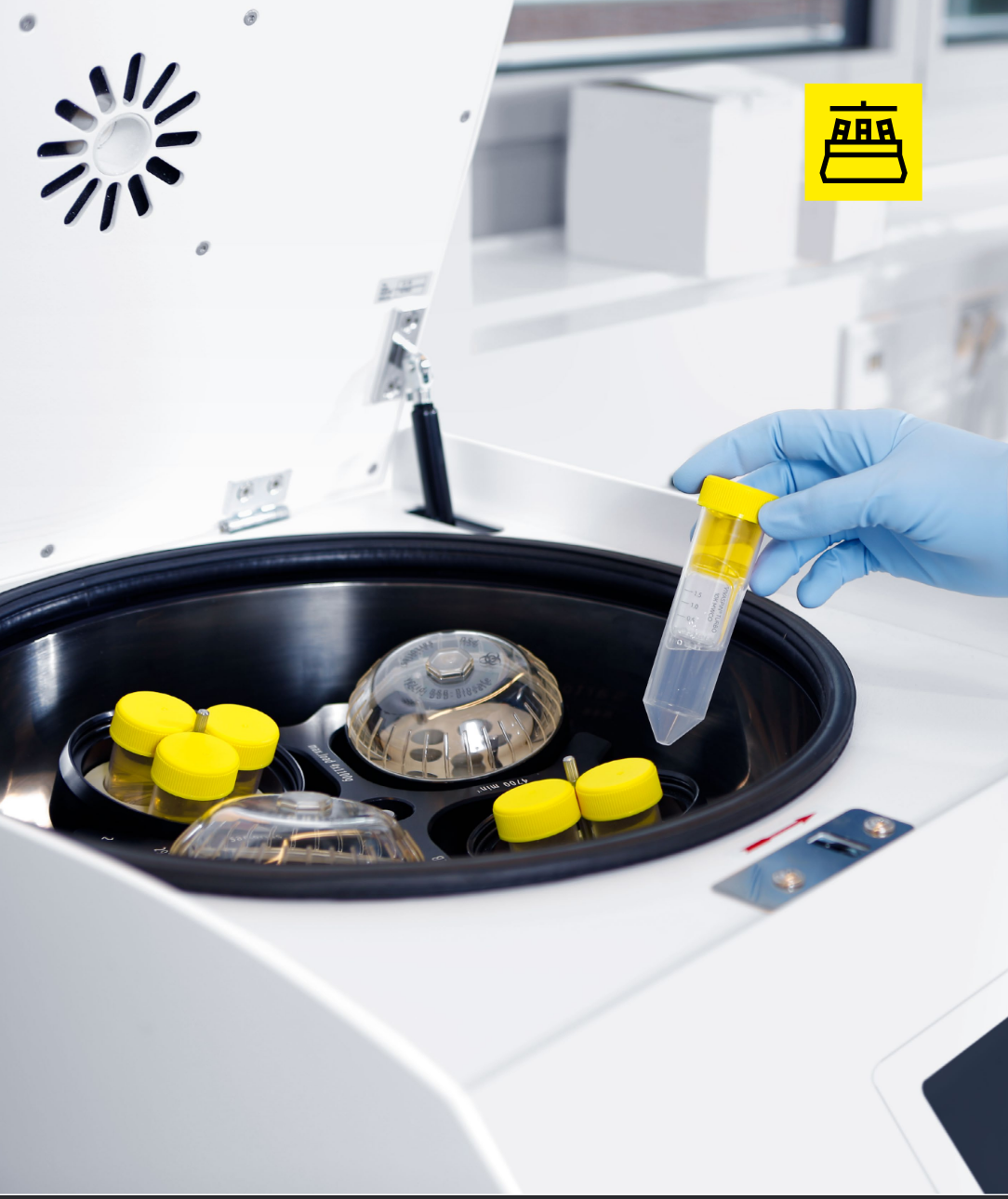
2. Centrifuge the tube
3. The bacteria now sits on the membrane (5 in the figure below)
4. Resuspend the bacteria in [diluent](/item-register/individual-items/dilution-liquid-5-l.md)
After step 4, you have a concentrated sample vial.
The bacteria stay on the retentate side (5 in the figure below) because the membrane pores are too small to let them through. Liquid and salts pushes through the membrane to the filtrate container (6 in the figure below).
See also [Filter-centrifuge your sample with Vivaspin® 20](/advanced/advanced-sample-preparation/hit-the-right-concentration/concentrate-your-sample/filter-centrifuge-your-sample/filter-centrifuge-your-sample-with-vivaspin-r-20.md).
## What kind of filter membranes?
We have found that 1 million MWCO membranes work best in terms of performance and recovery of intact bacteria. Several sizing options exist and we list some below.
### Vivaspin® 20
For standard benchtop centrifuges, [Vivaspin® 20](https://shop.sartorius.com/dk/p/vivaspin-20-centrifugal-concentrator-polyethersulfone-12-pc/VS2061) is easy to use. It fits in standard 50 mL centrifuge tube rotors.
You can even combine pressurization (see 2 in the figure above) and centrifugation.
{% content-ref url="/pages/alY9jCN5j9Nl5hXQGKaN" %}
[Filter-centrifuge your sample with Vivaspin® 20](/advanced/advanced-sample-preparation/hit-the-right-concentration/concentrate-your-sample/filter-centrifuge-your-sample/filter-centrifuge-your-sample-with-vivaspin-r-20.md)
{% endcontent-ref %}
### Vivaspin® 100
[Vivaspin® 100](https://shop.sartorius.com/dk/p/vivaspin-100-ultrafiltration-units/M_Vivaspin_100) has larger sample volume (90 mL). This allows you to concentrate more sample at a time. Like Vivaspin® 20, you can also fit the tube with a pressure cap.
---
# Agent Instructions
This documentation is published with GitBook. GitBook is the documentation platform designed so that both humans and AI agents can read, navigate, and reason over technical content effectively. Learn more at gitbook.com.
## Querying This Documentation
If you need additional information that is not directly available in this page, you can query the documentation by asking a question.
Perform an HTTP GET request on the following URL with the `ask` and `goal` query parameters:
```
GET https://help.sbtinstruments.com/advanced/advanced-sample-preparation/hit-the-right-concentration/concentrate-your-sample/filter-centrifuge-your-sample.md?ask=&goal=
```
`ask` is the immediate question: it should be specific, self-contained, and written in natural language.
`goal` is what the user is ultimately trying to achieve, the reason they need the answer. Sharing it helps GitBook give you a better, more relevant answer. A goal is most helpful when it describes the outcome the user wants rather than restating the question. For example, with `ask=how do I create an API token`, a goal like `automate deployments from our CI pipeline` lets GitBook tailor the answer to that use case.
The response will contain a direct answer to the question and relevant excerpts and sources from the documentation.
Use this mechanism when the answer is not explicitly present in the current page, you need clarification or additional context, or you want to retrieve related documentation sections.