> For the complete documentation index, see [llms.txt](https://help.sbtinstruments.com/llms.txt). Markdown versions of documentation pages are available by appending `.md` to page URLs; this page is available as [Markdown](https://help.sbtinstruments.com/advanced/advanced-sample-preparation/prepare-sludge-and-fecal-samples.md).

# Prepare sludge and fecal samples

Free the bacteria from particles and clumps, then dilute and measure.

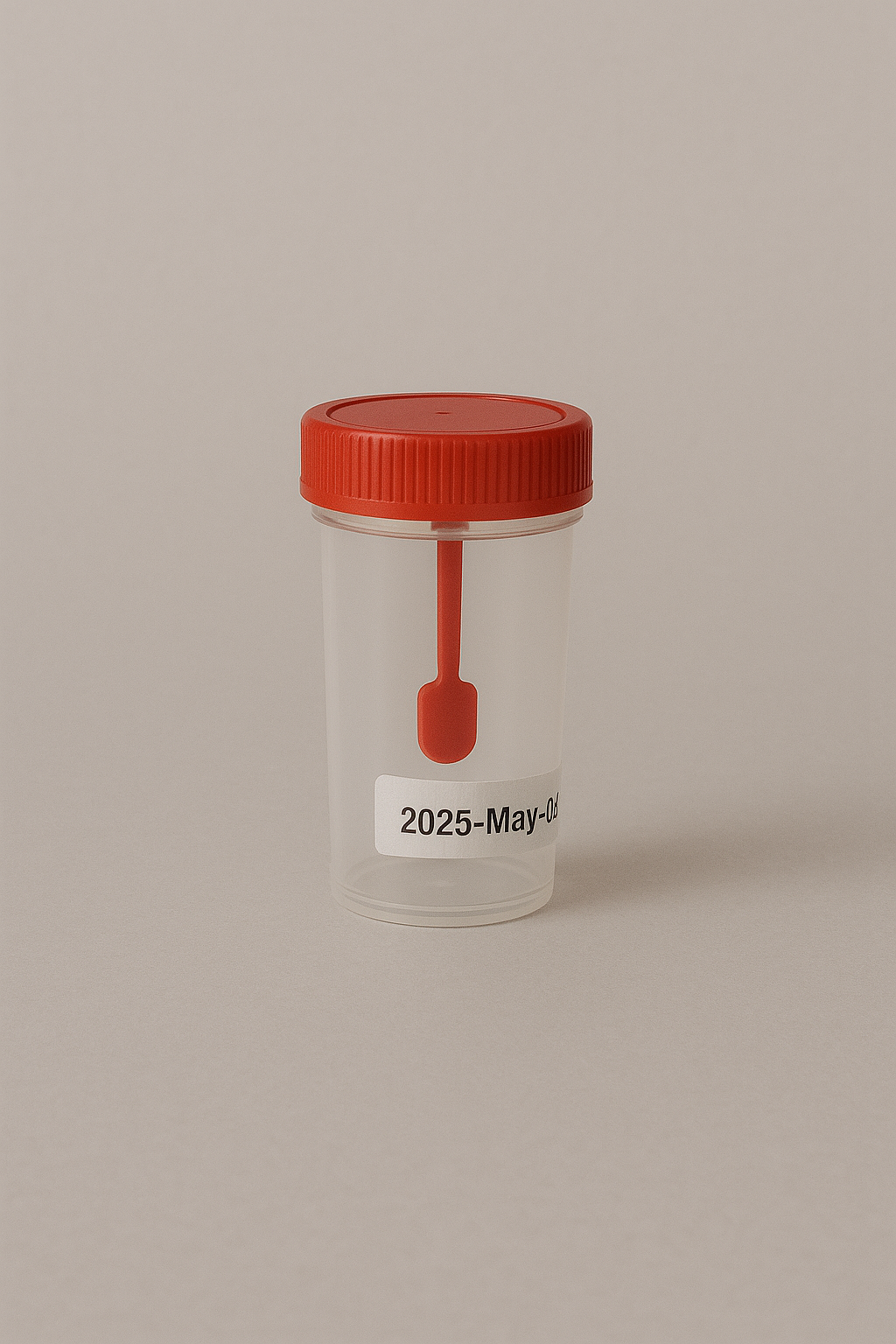
<div><figure><img src="https://2483617760-files.gitbook.io/~/files/v0/b/gitbook-x-prod.appspot.com/o/spaces%2FCaBGkox4Fd7NCFFCF47X%2Fuploads%2F5NGTkuLXLjYSYT8NEZw0%2Fstool-container.png?alt=media" alt="" width="375"><figcaption><p>Container for fecal (stool) samples.</p></figcaption></figure> <figure><img src="https://2483617760-files.gitbook.io/~/files/v0/b/gitbook-x-prod.appspot.com/o/spaces%2FCaBGkox4Fd7NCFFCF47X%2Fuploads%2FQfeKufdbWx0iDAJqYAX6%2Ffermenter-sample.png?alt=media" alt="" width="375"><figcaption><p>Fermenter sample with a lot of debris.</p></figcaption></figure></div>

Wastewater sludge and fecal (stool) samples contain a lot of material that is not bacteria. Use this page for any sample like that. Before you measure, free the bacteria from particles and clumps, and remove the large particles.

{% hint style="warning" %}
**Contact SBT before you start**

[BacTotal-10](/advanced/measurements-explained/gating/bactotal-10.md) is the default measurement program. It is built for samples that contain mostly bacteria. In samples like these, non-bacterial particles of the same size can be counted as cells. BacTotal-10 is therefore not necessarily the optimal choice for your samples.

We always recommend that you contact us to discuss how to move forward. See also [Custom gating](/advanced/measurements-explained/gating/custom-gating.md).
{% endhint %}

<a href="https://sbtinstruments.com/contact" class="button primary">Contact us</a>

## Why sample preparation matters

Bacteria that sit on a particle, or stick together in a clump, are not counted correctly. This applies to BactoBox® and to plate counts alike. A clump passes the sensor as one object, so it lowers the count and raises the cell size.

See [Break up cell clumps](/more/how-to-guides/break-up-cell-clumps.md).

## Overall approach

1. Disaggregate the sample, to free the bacteria from particles and from each other.
2. Filter the sample through a 10 µm [cell sieve](/item-register/consumables/cell-sieve-10-m.md), to remove large particles.
3. Dilute and measure the sample.

## Protocol

<figure><img src="https://2483617760-files.gitbook.io/~/files/v0/b/gitbook-x-prod.appspot.com/o/spaces%2FCaBGkox4Fd7NCFFCF47X%2Fuploads%2FzBGubBWS2HTUJtURcQzR%2Fsludge-fecal-dilution-series-large.svg?alt=media&amp;token=4f3fe94a-9b54-46b9-a0d7-6b7e23e4678a" alt="Dilution series for sludge and fecal samples"><figcaption><p>The protocol from left to right. Add 1 g of sample to 9 mL peptone water, a 1:10 dilution. Add 3 g glass beads and bead-beat. Filter through a 10 µm cell sieve. Transfer 101 µL into 10 mL diluent, twice. Each transfer is a 1:100 dilution, so the two vials hold your sample diluted 1:1 000 and 1:100 000 in total.</p></figcaption></figure>

{% stepper %}
{% step %}

#### Mix the sample before you take a portion

Make the sample as uniform as possible before you take a portion of it. Shake it, vortex it or stir it with a magnetic stirrer.

If the sample is solid or hard to pipette, weigh it instead.
{% endstep %}

{% step %}

#### Disaggregate

1. Fill a flip-top tube with 9 mL buffered peptone water.
2. Add 1 mL or 1 g of sample. This is the first dilution, 1:10.
3. Add 3 g of [3 mm glass beads](/item-register/consumables/glass-beads-3-mm-50-g.md).
4. Bead-beat for 1 minute at maximum speed, or vortex for 3 minutes at maximum speed.
5. Note the final liquid volume in the tube. It is the buffer plus your sample, about 10 mL. Do not count the beads.

Keep the bead beater away from BactoBox®. Strong vibration can affect measurements and damage the device.

If you have a microscope, check that the bacteria are single cells and free of particles. See [Break up cell clumps](/more/how-to-guides/break-up-cell-clumps.md).
{% endstep %}

{% step %}

#### Remove large particles

1. Fit a [10 µm cell sieve](/item-register/consumables/cell-sieve-10-m.md) to a 3 mL syringe.
2. Remove the piston and decant 3 mL of the disaggregated sample into the syringe.
3. Filter 1–2 mL of sample into an [empty vial](/item-register/individual-items/empty-vial.md).
   {% endstep %}

{% step %}

#### Dilute

Prepare two [dilution vials](/item-register/individual-items/dilution-vial.md). Add 10 mL of [diluent](/item-register/individual-items/dilution-liquid-5-l.md) to each of two [empty vials](/item-register/individual-items/empty-vial.md).

1. Transfer 101 µL of the filtered sample into the first vial. This is a 1:100 dilution. Together with the first 1:10 dilution, your sample is now diluted 1:1 000 in total.
2. Transfer 101 µL from the first vial into the second vial. This is another 1:100 dilution. Your sample is now diluted 1:100 000 in total.

After every transfer, vortex at maximum speed for at least 10 seconds. Check that a cyclone forms in the vial. Rinse the pipette tip by aspirating and dispensing a few times in the vial you dispensed into.

See [Run a sample](/everyday-use/run-a-sample.md).
{% endstep %}

{% step %}

#### Measure

1. Run Clean with a fresh disinfection vial.
2. Measure the second vial (1:100 000) first. Accept the result if it is within the measuring range, 3 × 10⁴ to 5 × 10⁶ cells/mL.
3. If the result is below the range, or close to its lower end, also measure the first vial (1:1 000).

Measure in [Access](/everyday-use/do-measurements-in-access.md), so the dilution factor and the sample label are stored with each result.

Is even the first vial below the measuring range? Contact us to discuss your options.
{% endstep %}
{% endstepper %}

## Calculate the result

Multiply the result by the total dilution factor, 1 000 for the first vial or 100 000 for the second vial. For a pipetted sample, this gives cells/mL in your sample. For a weighed sample, it gives cells/g.

The total dilution factor assumes the first dilution is 1:10. If you added a different amount of sample, or the final liquid volume is not 10 mL, replace the 10 with the final volume (mL) divided by the amount of sample (mL or g).

For example, the second vial reads 2.0 × 10⁵ cells/mL, and you weighed 1 g of sample into the tube. Your sample then holds 2.0 × 10⁵ × 100 000 = 2.0 × 10¹⁰ cells/g.


---

# Agent Instructions
This documentation is published with GitBook. GitBook is the documentation platform designed so that both humans and AI agents can read, navigate, and reason over technical content effectively. Learn more at gitbook.com.

## Querying This Documentation
If you need additional information that is not directly available in this page, you can query the documentation by asking a question.

Perform an HTTP GET request on the following URL with the `ask` and `goal` query parameters:

```
GET https://help.sbtinstruments.com/advanced/advanced-sample-preparation/prepare-sludge-and-fecal-samples.md?ask=<question>&goal=<user_goal>
```

`ask` is the immediate question: it should be specific, self-contained, and written in natural language.
`goal` is what the user is ultimately trying to achieve, the reason they need the answer. Sharing it helps GitBook give you a better, more relevant answer. A goal is most helpful when it describes the outcome the user wants rather than restating the question. For example, with `ask=how do I create an API token`, a goal like `automate deployments from our CI pipeline` lets GitBook tailor the answer to that use case.

The response will contain a direct answer to the question and relevant excerpts and sources from the documentation.

Use this mechanism when the answer is not explicitly present in the current page, you need clarification or additional context, or you want to retrieve related documentation sections.
