> For the complete documentation index, see [llms.txt](https://help.sbtinstruments.com/llms.txt). Markdown versions of documentation pages are available by appending `.md` to page URLs; this page is available as [Markdown](https://help.sbtinstruments.com/advanced/measurements-explained/gating/bactotal-10.md).

# BacTotal-10

Our recommended default measurement program. What it counts, and how that compares to CFU.

## What BacTotal-10 counts

BacTotal-10 counts whole bacterial cells in your sample. The result is cells/mL.

In general, these all count:

* A cell that is dividing
* A cell that has stopped dividing
* A cell that no longer forms a colony
* A cell that takes up [propidium iodide](https://en.wikipedia.org/wiki/Propidium_iodide)

A cell that has lysed is not counted. A cell that has come apart is no longer there.

There are exceptions. Heat or alcohol can change a cell's electrical properties so much that BacTotal-10 no longer sees it as a cell. The same can happen to aged cells of some Gram-positive species. See [Inactivated bacteria](/advanced/measurements-explained/gating/inactivated-bacteria.md).

Particles that do not look like bacteria, such as debris, count towards total/mL but not cells/mL.

Cells/mL is not OD600. OD is often read as a rough cell count, but it is not one. It adds up cell number, cell size and shape, the optical properties of the cells, and the medium. When OD behaves unexpectedly, one of these has usually changed. See [Understanding OD600](https://sbtinstruments.com/knowledge/understanding-od600).

## How cells/mL compares to CFU

CFU counts the cells that form a colony under your plating conditions. That is culturability.

We calibrated cells/mL against CFU/mL for six species in a peer-reviewed study ([Jordal et al., 2025](https://www.sciencedirect.com/science/article/pii/S0167701225002003)). BacTotal-10 multiplies the raw cell count by 1.46, the empirical concentration correction (ECC) factor, so that cells/mL ≈ CFU/mL for actively growing cultures. See [Precision and accuracy](/item-register/bactobox-r/precision-and-accuracy.md).

Your own plate counts may differ from cells/mL by a small factor, because organisms and plating methods differ. For a given process, that factor stays the same while the culture grows. You can use it to convert cells/mL to your CFU/mL.

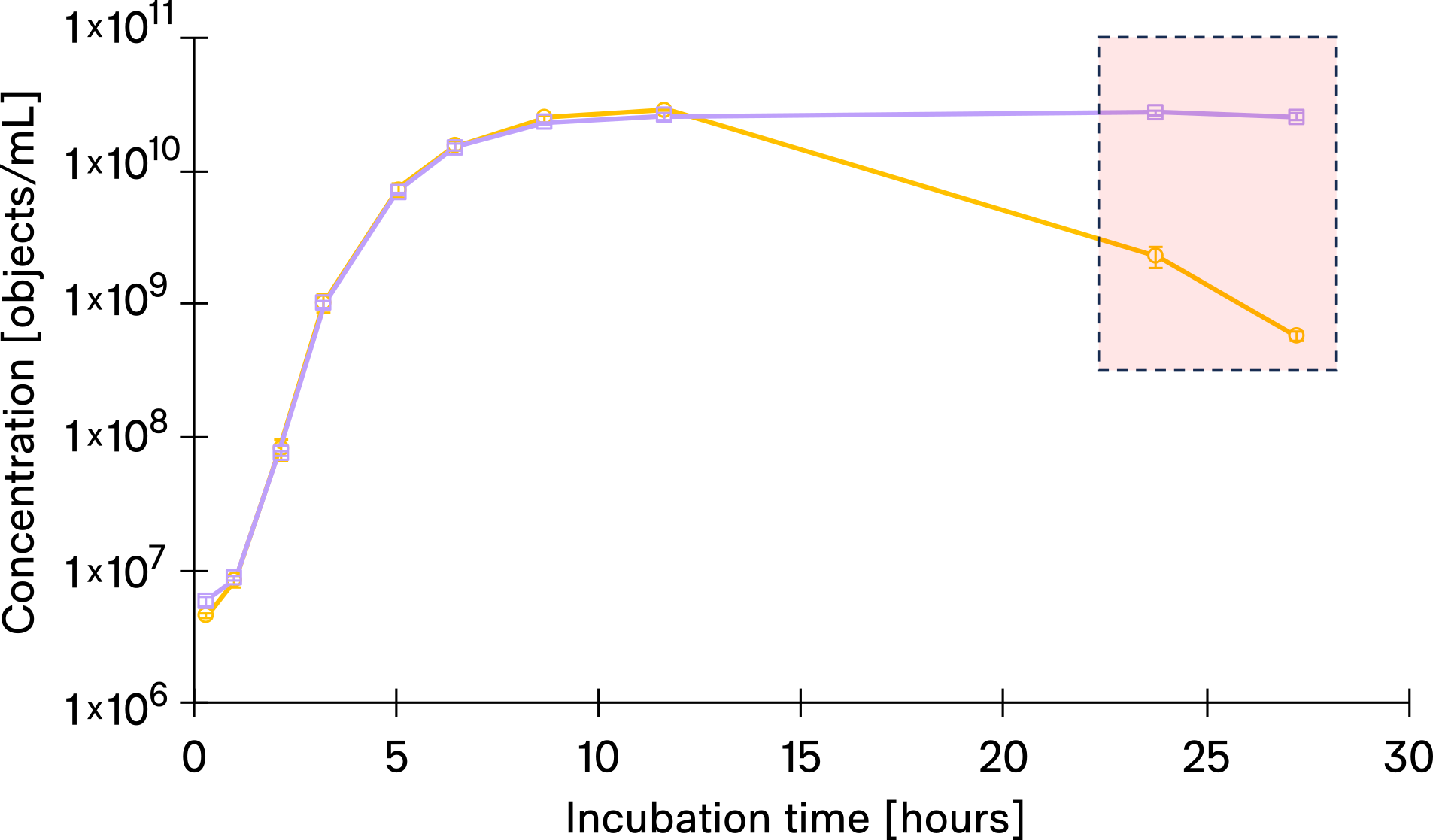
Cells/mL and CFU/mL track each other closely through exponential and early stationary phase. They separate in decline phase. Cells stop forming colonies, so CFU falls. BacTotal-10 does not see that loss.

<figure><img src="https://2483617760-files.gitbook.io/~/files/v0/b/gitbook-x-prod.appspot.com/o/spaces%2FCaBGkox4Fd7NCFFCF47X%2Fuploads%2FfVXfx2FLKso5huOfRkPb%2Fklebsiella-decline.png?alt=media" alt="K. aerogenes growth curve measured with BactoBox and plate counts. CFU falls in decline phase while cells/mL stays close to flat." width="375"><figcaption><p><em>K. aerogenes</em> in TSB. BactoBox® cells/mL (lavender) and CFU/mL (yellow), triplicates. The two agree while the culture grows. In decline phase (red box), CFU falls to about 10 % of its peak by 24 hours, while cells/mL stays close to flat.</p></figcaption></figure>

Harvest as soon as BactoBox® shows that growth has stopped, or when cell size has plateaued. Use whichever signal works better for your process. See [Identifying the harvest point](https://sbtinstruments.com/knowledge/identifying-the-harvest-point).

## BacTotal-10 does not measure live-dead

BacTotal-10 does not tell live cells from dead cells. We do not see a need for it in growth work. Only live cells divide, so a rising cells/mL means the culture is growing, and any cell death is negligible. When conditions get worse, cells stop dividing first and die later.

Read more in [Are live-dead measurements needed?](https://sbtinstruments.com/knowledge/are-live-dead-measurements-needed)

## Why BacTotal-10 is the default

We recommend BacTotal-10 for all work. BactoBox® uses it by default when you press <kbd>Measure</kbd>. It works across species and media with no setup. Its limits are known, and each one has a workaround.

| Limit                                                            | What to do                                                                                  |
| ---------------------------------------------------------------- | ------------------------------------------------------------------------------------------- |
| A clump or chain counts as one cell                              | [Break up cell clumps](/more/how-to-guides/break-up-cell-clumps.md)                         |
| Some media add background at low dilutions                       | [Check medium background](/more/how-to-guides/check-medium-background.md)                   |
| Loss of culturability is not seen                                | Harvest when growth stops                                                                   |
| Some heat-treated, alcohol-treated or aged cells are not counted | Talk to SBT about [Custom gating](/advanced/measurements-explained/gating/custom-gating.md) |
| Species are not told apart                                       | The count is the sum of everything growing                                                  |

BacTotal-10 is short for BacTotal\_v2024-10.

## Changing the measurement program

Talk to SBT before you use anything other than BacTotal-10. We agree any change with you first, so you know what the new numbers mean. See [Custom gating](/advanced/measurements-explained/gating/custom-gating.md) and [Legacy gating settings](/advanced/measurements-explained/gating/legacy-gating-settings.md). [Contact us](https://sbtinstruments.com/contact).

Once we have agreed a change, see [Gating in Access](/advanced/gating-in-access/turn-on-gating-in-access.md) for how to make it.


---

# Agent Instructions
This documentation is published with GitBook. GitBook is the documentation platform designed so that both humans and AI agents can read, navigate, and reason over technical content effectively. Learn more at gitbook.com.

## Querying This Documentation
If you need additional information that is not directly available in this page, you can query the documentation by asking a question.

Perform an HTTP GET request on the following URL with the `ask` and `goal` query parameters:

```
GET https://help.sbtinstruments.com/advanced/measurements-explained/gating/bactotal-10.md?ask=<question>&goal=<user_goal>
```

`ask` is the immediate question: it should be specific, self-contained, and written in natural language.
`goal` is what the user is ultimately trying to achieve, the reason they need the answer. Sharing it helps GitBook give you a better, more relevant answer. A goal is most helpful when it describes the outcome the user wants rather than restating the question. For example, with `ask=how do I create an API token`, a goal like `automate deployments from our CI pipeline` lets GitBook tailor the answer to that use case.

The response will contain a direct answer to the question and relevant excerpts and sources from the documentation.

Use this mechanism when the answer is not explicitly present in the current page, you need clarification or additional context, or you want to retrieve related documentation sections.
