
> For the complete documentation index, see [llms.txt](https://help.sbtinstruments.com/llms.txt). Markdown versions of documentation pages are available by appending `.md` to page URLs; this page is available as [Markdown](https://help.sbtinstruments.com/more/how-to-guides/check-medium-background.md).

# Check medium background

Some particles in your growth medium can end up in your cells/mL result. Measure your medium to find out, and correct for it if it matters.

With BacTotal-10, the default measurement program, some particles from your growth medium can be erroneously classified as cells.

Whether that matters depends on how many cells your sample holds compared with the particles in your medium. A dense culture, at 1 × 10^8 cells/mL or more, far outnumbers the background. It matters most when your culture is dilute, for example early in growth. Measure your medium once to know where you stand.

<figure><img src="https://2483617760-files.gitbook.io/~/files/v0/b/gitbook-x-prod.appspot.com/o/spaces%2FCaBGkox4Fd7NCFFCF47X%2Fuploads%2Fgit-blob-b439ed067c285a4eab9316f44f4c5fb15b11da2e%2FShake_flask_particulates.png?alt=media" alt="" width="375"><figcaption></figcaption></figure>

## Measure your medium

Measure your growth medium before you inoculate it.

1. Vortex a sample of your medium for 10 seconds at maximum speed.
2. Dilute 1:100. Add 101 µL of medium to 10 mL of diluent, [rinse the tip](/more/how-to-guides/basic-sample-preparation.md), and vortex for 10 seconds at maximum speed.
3. Move the tubing kit to the diluted sample and press <kbd>Measure</kbd>.

{% hint style="warning" %}
If you get the error *conductivity too high*, your medium is too conductive for a 1:100 dilution. Use 1:201 instead, which is 50 µL of medium in 10 mL of diluent.
{% endhint %}

## Decide if it matters

Compare your medium with your sample at the same dilution. For example, if your medium reads 50 000 cells/mL at 1:100 and your sample reads 500 000 cells/mL at 1:100, about 10 % of your count is background.

A background at 1:100 is rarely a problem. Your culture grows, but the background does not. Once your culture is dense enough to measure at 1:1 000, your medium usually reads below the limit of detection at that dilution, while your sample reads well within the working range. Measure your medium at 1:1 000 to see this for yourself.

Background matters most early in growth, when you measure at 1:100.

## Correct for medium background

There are several ways to correct for medium background.

### Filter the growth medium

Dissolve the powder fully with a magnetic stirrer, let the medium cool to room temperature, then pass it through a 0.2 µm vacuum filter before autoclaving.

{% hint style="warning" %}
Do not filter media whose particulates the organism needs, such as media containing serum or lipids. Filter the individual components instead and leave the final formulation alone.
{% endhint %}

### Subtract a constant background

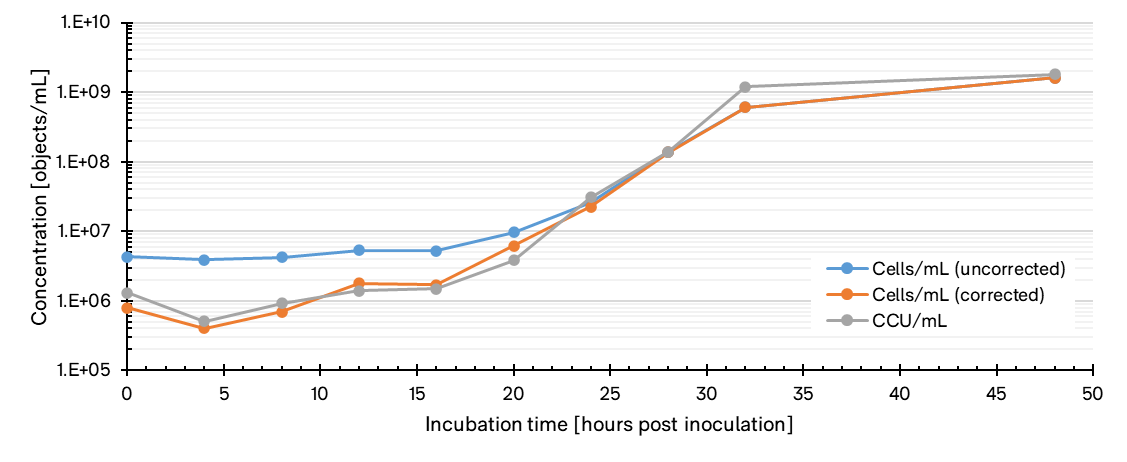
If the background stays constant over time, multiply your medium's reading by its dilution factor and subtract that from each sample's final concentration.

<figure><img src="https://2483617760-files.gitbook.io/~/files/v0/b/gitbook-x-prod.appspot.com/o/spaces%2FCaBGkox4Fd7NCFFCF47X%2Fuploads%2Fgit-blob-6d0df230560c58ceaaebe97f53109c38ba2e13b9%2Fmitigate-background--subtract-mycoplasma-growth-curve.png?alt=media" alt=""><figcaption><p><em>Mycoplasma gallisepticum</em> in a medium carrying about 4×10⁶ cells/mL of background. The uncorrected measurements (blue) sit above the colour-changing units (grey) through lag phase. Subtracting the background (orange) brings the two into line. Past mid-exponential phase the culture far exceeds the background and the correction stops mattering.</p></figcaption></figure>

### Stricter gating

BacTotal-10 uses broad rules to separate bacteria from non-bacterial objects. A stricter gate can raise the contrast between the two for your particular medium. Building one is development work rather than a setting you can change, so SBT offers it as a paid [custom solution](/advanced/what-is-a-custom-solution.md).

[Contact us](https://sbtinstruments.com/contact) to start that conversation.


---

# Agent Instructions
This documentation is published with GitBook. GitBook is the documentation platform designed so that both humans and AI agents can read, navigate, and reason over technical content effectively. Learn more at gitbook.com.

## Querying This Documentation
If you need additional information that is not directly available in this page, you can query the documentation by asking a question.

Perform an HTTP GET request on the following URL with the `ask` and `goal` query parameters:

```
GET https://help.sbtinstruments.com/more/how-to-guides/check-medium-background.md?ask=<question>&goal=<user_goal>
```

`ask` is the immediate question: it should be specific, self-contained, and written in natural language.
`goal` is what the user is ultimately trying to achieve, the reason they need the answer. Sharing it helps GitBook give you a better, more relevant answer. A goal is most helpful when it describes the outcome the user wants rather than restating the question. For example, with `ask=how do I create an API token`, a goal like `automate deployments from our CI pipeline` lets GitBook tailor the answer to that use case.

The response will contain a direct answer to the question and relevant excerpts and sources from the documentation.

Use this mechanism when the answer is not explicitly present in the current page, you need clarification or additional context, or you want to retrieve related documentation sections.
