> For the complete documentation index, see [llms.txt](https://help.sbtinstruments.com/llms.txt). Markdown versions of documentation pages are available by appending `.md` to page URLs; this page is available as [Markdown](https://help.sbtinstruments.com/mpd/encyclopedia/track-growth-curve/1-100-dilution-post-inoculation.md).
# 1:100 dilution after inoculation
Once the shake flask is inoculated, immediately collect a sample to obtain a measurement as close to T0 as possible.
{% stepper %}
{% step %}
**Prepare the sample for BactoBox® measurement**
1. Use a serological pipette to transfer a sample from the shake flask to a vial.
2. Use a permanent marker to label the vial cap with the sampling time.
3. Return the shake flask to the incubator shaker.
4. Start a 30-minute countdown to remind you to collect the next sample.
5. Vortex 30 seconds at max speed to disaggregate[^1] bacteria.
6. Dilute 1:100 in diluent by adding 101 µL of sample to 10 mL of diluent. Vortex 10 sec., max speed.
7. Transfer the tubing kit to the diluted sample.
{% hint style="success" %}
#### Put the flask back in the incubator shaker immediately after collecting the sample.
Collect the sample quickly to ensure prompt return. Minimize the time the flask is outside the incubator shaker to avoid drops in temperature and dissolved oxygen levels.
{% endhint %}
{% endstep %}
{% step %}
**Measure the diluted sample on BactoBox®**
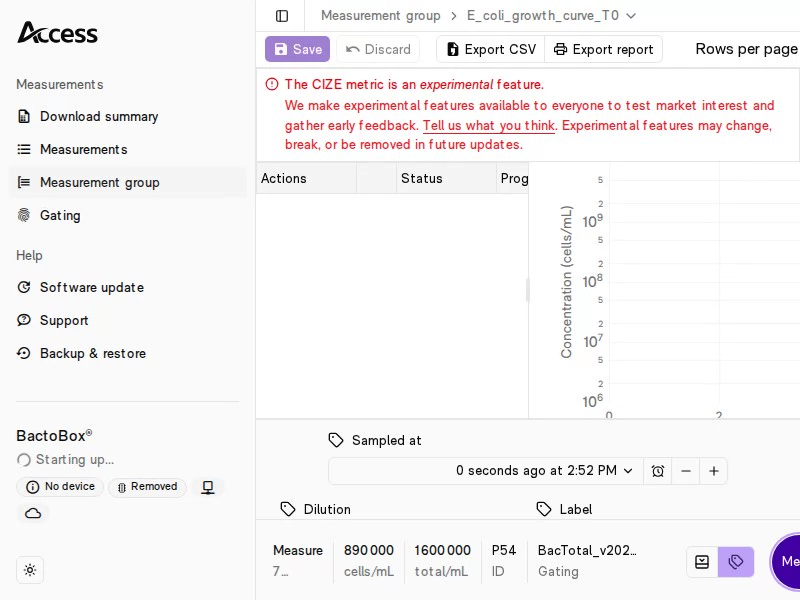
1. Add metadata:
1. Dilution: 100.
2. Label: E\_coli\_growth.
2. Click the Measure button in Access.
3. Once measurement is done, click the label E\_coli\_growth above the chart to visualize the growth curve data.
{% hint style="danger" %}
## Do you get the error *conductivity too high*?
Some cultivation media have very high conductivity and a 1:100 dilution in standard diluent is not sufficient to bring the diluted sample within the accepted conductivity limits.
You can typically solve this issue by using a 1:201 dilution: Simply add 50 µL of sample to 10 mL of diluent. For more information, please see the section [Hit the right conductivity](/advanced/advanced-sample-preparation/hit-the-right-conductivity.md).
{% endhint %}
{% endstep %}
{% step %}
**Clean the device**
1. Transfer the tubing kit to the disinfection vial.
2. Click Clean.
{% endstep %}
{% endstepper %}
## Summary
You now know the bacterial concentration at T0. Next we will collect a sample for every 30 min and keep repeating the 1:100 dilution scheme for lag and early exponential growth stage.
[^1]: Break up clumps or chains of cells
---
# Agent Instructions
This documentation is published with GitBook. GitBook is the documentation platform designed so that both humans and AI agents can read, navigate, and reason over technical content effectively. Learn more at gitbook.com.
## Querying This Documentation
If you need additional information that is not directly available in this page, you can query the documentation by asking a question.
Perform an HTTP GET request on the following URL with the `ask` and `goal` query parameters:
```
GET https://help.sbtinstruments.com/mpd/encyclopedia/track-growth-curve/1-100-dilution-post-inoculation.md?ask=&goal=
```
`ask` is the immediate question: it should be specific, self-contained, and written in natural language.
`goal` is what the user is ultimately trying to achieve, the reason they need the answer. Sharing it helps GitBook give you a better, more relevant answer. A goal is most helpful when it describes the outcome the user wants rather than restating the question. For example, with `ask=how do I create an API token`, a goal like `automate deployments from our CI pipeline` lets GitBook tailor the answer to that use case.
The response will contain a direct answer to the question and relevant excerpts and sources from the documentation.
Use this mechanism when the answer is not explicitly present in the current page, you need clarification or additional context, or you want to retrieve related documentation sections.