# Screen growth media

| BactoBox® skill level   | Time to complete (E. coli)         | Hands-on time       | Requirements                                                                                                                                                                                                 |
| ----------------------- | ---------------------------------- | ------------------- | ------------------------------------------------------------------------------------------------------------------------------------------------------------------------------------------------------------ |
| :school\_satchel: Basic | :hourglass\_flowing\_sand: 8 hours | :stopwatch: 2 hours | <i class="fa-hard-drive">:hard-drive:</i> [7.6a](/encyclopedia/item-register/bactobox-r/bactobox-r-hardware-changelog.md) <i class="fa-floppy-disk">:floppy-disk:</i> [v2026.02a](/encyclopedia/software.md) |

Maximizing CFU/mL is crucial for producing bacterial vaccines, probiotics, soil bio-stimulants, and live biotherapeutics. The growth medium significantly influences the maximum achievable cell concentrations.

<figure><img src="/files/VZLXcKT7dHCecpOA5Fxp" alt="" width="375"><figcaption></figcaption></figure>

## BactoBox® cells as proxy for max CFU/mL

BactoBox® cells/mL serve as an effective proxy for determining maximum CFU/mL in a given growth medium. Obviously, BactoBox® offers greater speed and precision than traditional plate counts. But crucially, BactoBox® maintains a stable cell concentration after reaching the [stationary phase](/mpd/cell-growth/growth-phases.md) (see lavender curve below).

Contrary to this, plate counts (yellow curve below), usually drops during decline phase and may take different times to plateau across media types. This makes BactoBox® advantageous, allowing for more relaxed sampling without compromising result accuracy. Overall the rationale is that - if present in the growth medium - the cell must have been alive at one point in time.

The explainer section [Carrying capacity, Κ](/mpd/cell-growth/carrying-capacity-k.md) provides more insights on the benefits of using BactoBox® for determining max cell concentration.

<div align="center"><figure><img src="/files/QfncAFZkxfsp3VKOoHus" alt="" width="375"><figcaption><p><em>K. aerogenes</em> shake flask growth curve. The data points represent BactoBox® (lavender) and plate counts (yellow). The grey box highlights the stationary and decline phases.</p></figcaption></figure></div>

## A simple experiment on a bacterial sample

This workflow gives you a simple step by step guide to screen which growth medium results in the highest cell concentrations. You will get a feel for how to analyze a concentrated bacterial sample by serial dilutions and BactoBox® measurements. Subsequently, you can try other workflows like [Track growth curve](/mpd/workflows/track-growth-curve.md) to determine growth rate and [Determine best harvest time for max CFU/mL in batch cultivation](/mpd/workflows/optimize-harvest-time-for-max-cfu-ml-in-batch-cultivation.md) to determine optimal harvest time.

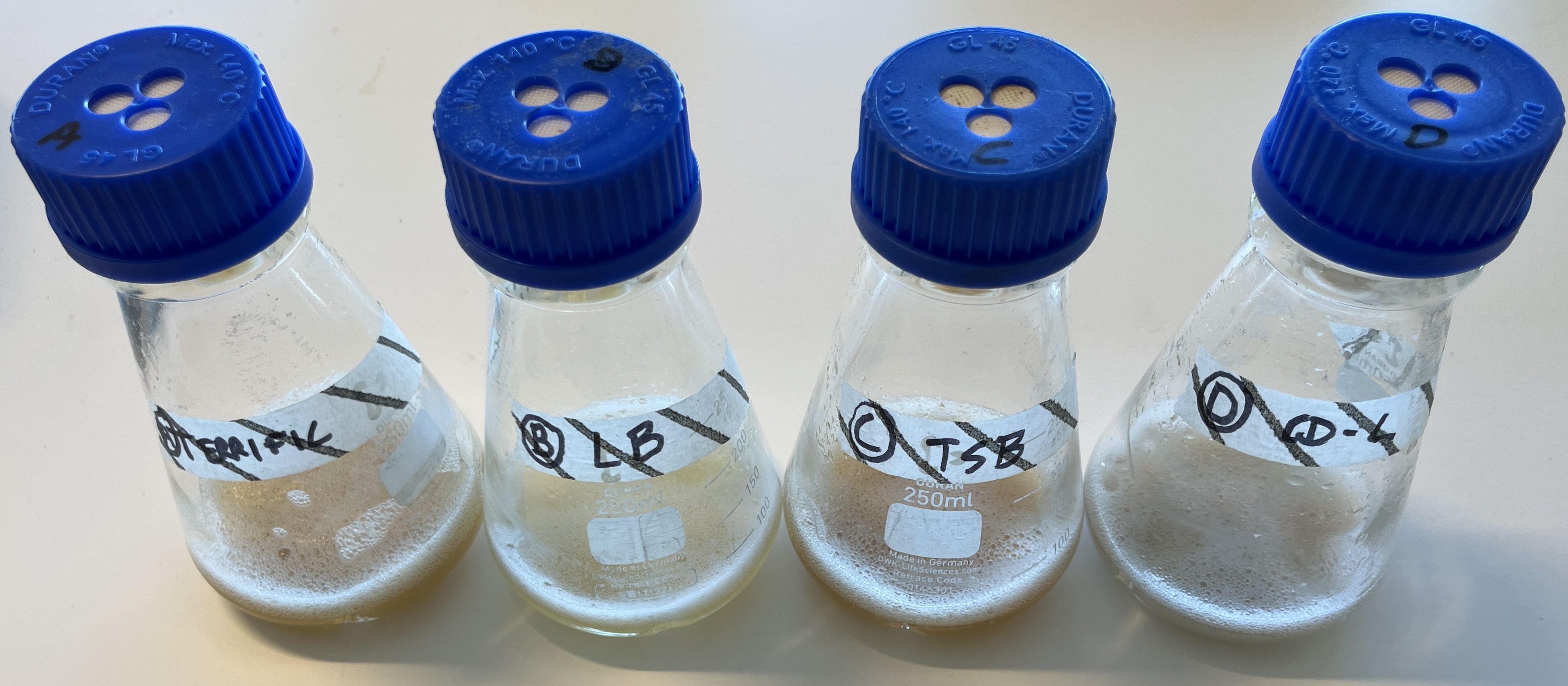
We show an example with four different growth media inoculated with the same *E. coli* starter culture. We suggest that you compare at least two different growth media. The workflow assumes that the cultures have been prepared in advance. The section [Get starter culture](/mpd/workflows/get-starter-cultures.md) gives information on how to prepare the cultures for the experiments, but you are also welcome to use your own standard operating protocols.

The workflow is illustrated below: A culture is inoculated 24 hours before the experiment, to be well within the stable plateau by the first BactoBox® measurement in the morning. Subsequent measurements occur around noon, 4 hours later. The final BactoBox® measurement takes place in the afternoon, approximately 4 hours afterward.

<figure><img src="/files/8btucp9AGPNiTnO4Q8xg" alt=""><figcaption><p>Example of inoculation time and sampling time. The goal is to get three measurement points within the stable plateau where cell concentrations are maximal. Note that the illustration is for demonstration only; the workflow does not lead to a full growth curve.</p></figcaption></figure>

## Overview

The overall steps in the workflow are given below.

1. [Get things ready](/mpd/workflows/best-medium/get-things-ready.md)
2. [Create measurement group](/mpd/workflows/best-medium/create-measurement-group.md)
3. [Morning measurement](/mpd/workflows/best-medium/check-remaining-cultures.md)
4. [Noon measurement](/mpd/workflows/best-medium/check-remaining-cultures-1.md)
5. [Afternoon measurement](/mpd/workflows/best-medium/check-remaining-cultures-2.md)
6. [Identify best medium](/mpd/workflows/best-medium/identify-best-medium.md)
7. [Summary](/mpd/workflows/best-medium/summary.md)

## Summary

You are now ready to use BactoBox® to find out which growth medium results in highest cell concentrations. Let's jump into it. First step is [Get things ready](/mpd/workflows/best-medium/get-things-ready.md).


---

# Agent Instructions: Querying This Documentation

If you need additional information that is not directly available in this page, you can query the documentation dynamically by asking a question.

Perform an HTTP GET request on the current page URL with the `ask` query parameter:

```
GET https://help.sbtinstruments.com/mpd/workflows/best-medium.md?ask=<question>
```

The question should be specific, self-contained, and written in natural language.
The response will contain a direct answer to the question and relevant excerpts and sources from the documentation.

Use this mechanism when the answer is not explicitly present in the current page, you need clarification or additional context, or you want to retrieve related documentation sections.
