> For the complete documentation index, see [llms.txt](https://help.sbtinstruments.com/llms.txt). Markdown versions of documentation pages are available by appending `.md` to page URLs; this page is available as [Markdown](https://help.sbtinstruments.com/software/access/pages/measurement-group/correlation-group-type.md).

# Correlation group type

Use this group type to:

* Create a growth curve
* Create a CFU-vs-BactoBox® plot

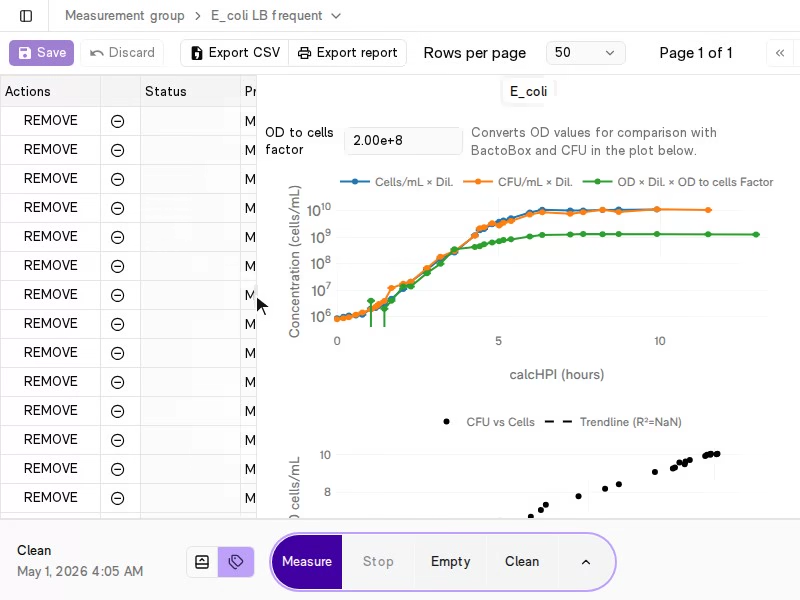
For the growth curve, we show up to three individual curves: Cells/mL, CFU/mL, and OD.

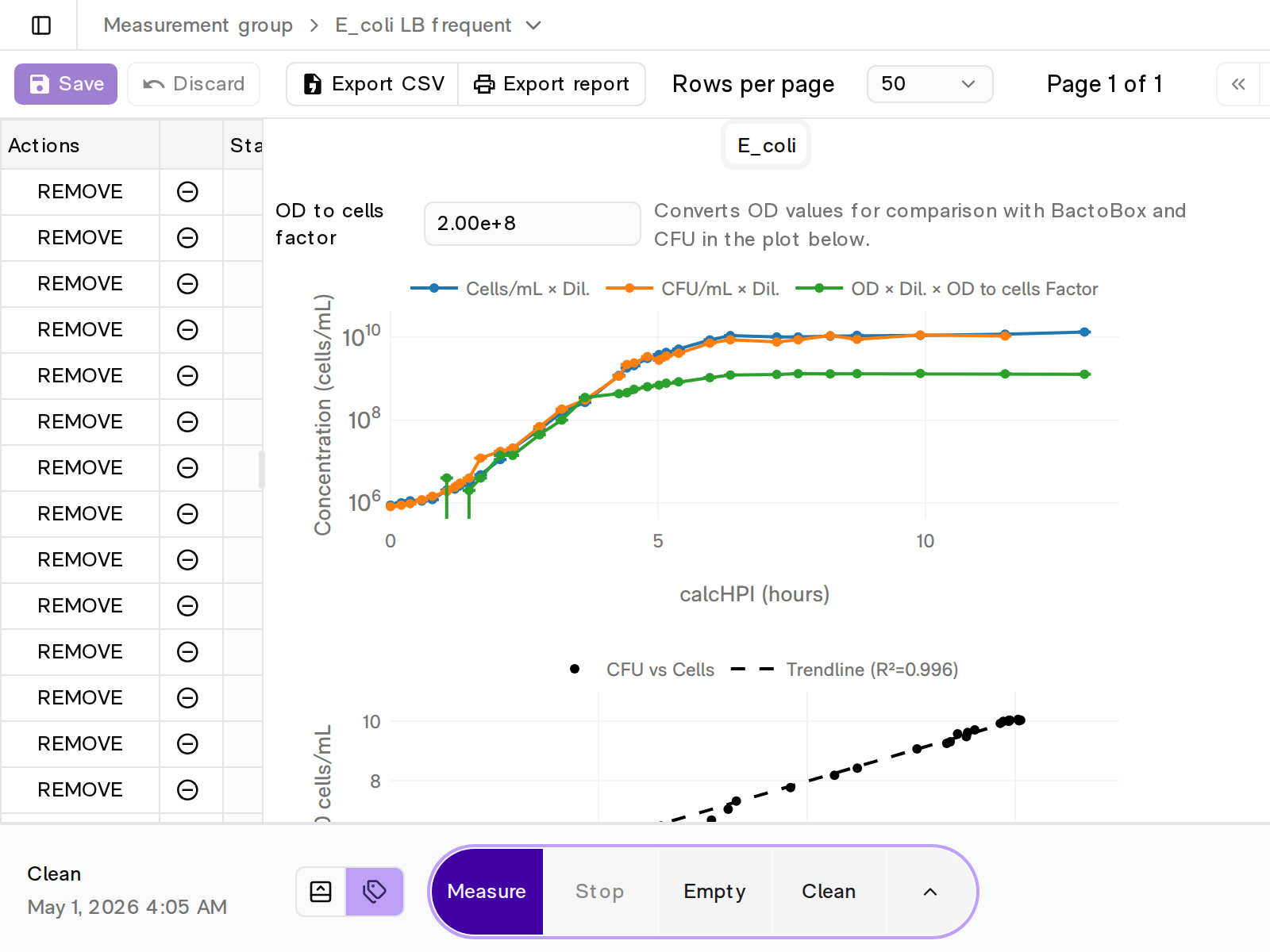
For the CFU-vs-BactoBox® plot, we use a log-log scale and add a trend line with an [R² value](https://en.wikipedia.org/wiki/Coefficient_of_determination).

<div data-with-frame="true"><figure><img src="/files/D4xmq1v9N72aPHtFl3tH" alt=""><figcaption><p>A <em>correlation</em>-type measurement group with 31 measurements. The view splits in the middle. There is a list of executions (left), a growth curve (top right), and a correlation plot vs CFU (bottom right).</p></figcaption></figure></div>

### Columns

The correlation group type generates two plots based on the following columns:

<table><thead><tr><th width="100">Plot</th><th>Column on x-axis</th><th>Column(s) on y-axis</th></tr></thead><tbody><tr><td>Growth curve</td><td><a href="/pages/zj23dRnsfDPMkc2gluMQ#how-calchpi-is-calculated">calcHPI</a></td><td><mark style="color:blue;">Cells/mL × Dil.</mark><br><mark style="color:orange;">CFU/mL × Dil.</mark><br><mark style="color:green;">OD × Dil. × OD to cells factor</mark></td></tr><tr><td>CFU-vs-BactoBox®</td><td>CFU/mL × Dil.<br><mark style="color:$info;">log10</mark></td><td>Cells/mL<br><mark style="color:$info;">log10</mark></td></tr></tbody></table>

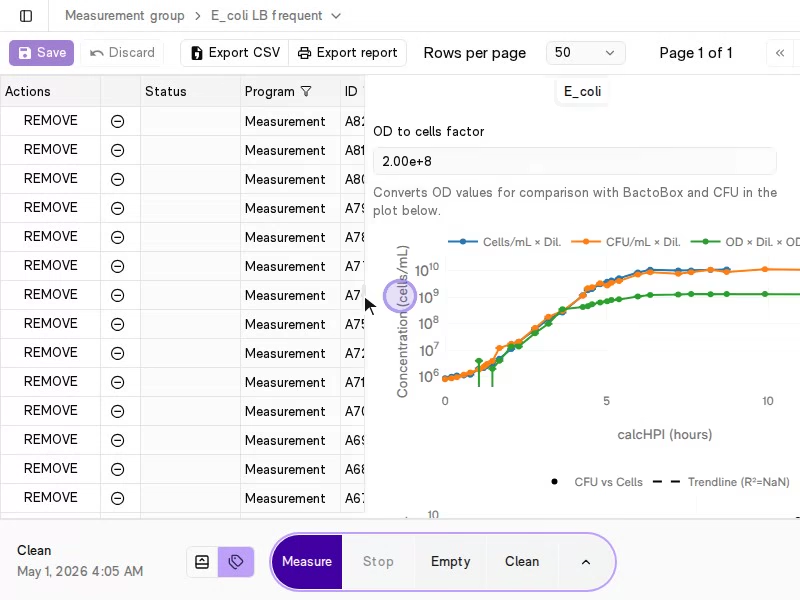
Initially, the plots are empty (no data points). The plots update live, as you start measurements and fill out the columns.

Naturally, the data points only appear in the plot if the corresponding columns have data.

<div data-with-frame="true"><figure><img src="/files/9GuGjBdM8YfNa3W42IaR" alt=""><figcaption><p>The plot updates live as you fill out the corresponding column. Note how even unsaved (pending) changes still affect the plot.</p></figcaption></figure></div>

<div data-with-frame="true"><figure><img src="/files/ml6ub7GgqdCDi4ZxuVTl" alt=""><figcaption><p>The trend line appears once you fill out the corresponding columns for <em>all</em> measurements in the group.</p></figcaption></figure></div>

### Tab per label

We use the *Label* column to group the measurements even further. For each label, we show a tab that contains the corresponding plots.

All measurements with an empty *Label* column go into the *Unlabelled* tab.


---

# Agent Instructions
This documentation is published with GitBook. GitBook is the documentation platform designed so that both humans and AI agents can read, navigate, and reason over technical content effectively. Learn more at gitbook.com.

## Querying This Documentation
If you need additional information that is not directly available in this page, you can query the documentation dynamically by asking a question.

Perform an HTTP GET request on the current page URL with the `ask` query parameter:

```
GET https://help.sbtinstruments.com/software/access/pages/measurement-group/correlation-group-type.md?ask=<question>
```

The question should be specific, self-contained, and written in natural language.
The response will contain a direct answer to the question and relevant excerpts and sources from the documentation.

Use this mechanism when the answer is not explicitly present in the current page, you need clarification or additional context, or you want to retrieve related documentation sections.